

HairDeck
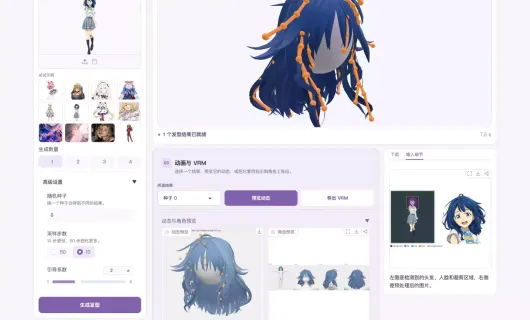
HairDeck generates animatable stylized hair cards with spring bones for avatars and games from a single character image
Note: Please open in the PC Client. Go to download >>>
Features
System Requirements
Minimum 16GB RAM. 20GB+ storage recommended.
macOS 15+: Supports M-series chips.
Windows 10/11: NVIDIA GPU with 8GB+ VRAM recommended.
Note: For NVIDIA GPUs, install a newer driver.Screenshots
Introduction
HairDeck is an open-source AI model developed by a research team mainly from Tsinghua University, in collaboration with Carnegie Mellon University and The Chinese University of Hong Kong.
Given only one character reference image as input, it automatically generates stylized, anime-ready hair cards, together with spring bone chains and UV data. The output assets can be exported as GLB files, or attached to a character avatar and exported in VRM 0.x format. You can directly import these assets into avatar platforms and game engines to achieve natural hair physics animation when the character moves.
Most existing image-to-3D methods produce realistic hair strands or a single fused mesh that cannot be split or animated separately. Traditionally, artists manually create hair cards one by one, arrange ribbons and set up bones, which is highly repetitive and time-consuming. HairDeck directly outputs editable, separated hair cards with pre-built physics rigging. Each ribbon can be adjusted independently without re-rigging, greatly lowering the barrier to stylized hair production.
Its core architecture is Set Diffusion Transformer (Set DiT). The hairstyle is treated as an unordered set of geometric primitives. Each hair card corresponds to one token; all cards are generated jointly rather than decoded autoregressively. It uses a frozen DINOv3 vision encoder to extract image condition features. Compared with previous methods, it reduces Chamfer distance by 44% and runs 33× faster. A separate Chain DiT module generates spring bone chains and skinning weights, and it can also add bones to existing static hair card assets.
Detailed Use Cases
VTuber Avatar Production Independent VTubers and avatar studios can quickly create new base models and alternate hairstyles. With one character illustration, you get physics-ready VRM hair for VSeeFace, Luppet, WARUDO and other tracking software. Hair will swing naturally when the avatar turns or tilts its head. It is ideal for hairstyle iteration, seasonal outfits and limited-time skins.
Anime-style Mobile & Indie Game Asset Pipeline Hair cards are the industry standard for real-time stylized rendering in Unity and Unreal Engine. They are lightweight and mobile-friendly. Game teams can batch-generate hair assets for NPCs, playable characters and DLC skins, rapidly prototyping art concepts and cutting manual workload.
Virtual Humans for Live Streaming & Short Videos AI digital humans for live streaming, virtual idols and short-video presenters. It converts 2D character art into animated 3D hair, compatible with common avatar driving systems for skits, educational content and live-stream sales.
3D Animation & MMD Creation MMD creators and anime animation studios. GLB exports can be imported into Blender, C4D and Maya for further animation and deformation. Creators can replace hairstyles on existing MMD models efficiently for fan-made animation works.
Industrial AIGC Character Workflows It can be integrated into image-to-character pipelines. Combined with image generation and general 3D models, it forms an end-to-end workflow: 2D character art → full 3D avatar with animated hair. Suitable for AI character platforms and stock asset market production.
Hobbyists, Students and CG Learners Individual creators and students without professional rigging skills can produce animatable cartoon hair easily for portfolios, school projects and fan art. No deep knowledge of hair physics or spring bone setup is required.
Retro-Rigging for Existing Hair Assets Beyond image generation, the model can automatically add spring bone chains to static handmade hair cards, adding physics animation to old CG assets.
One-sentence summary: HairDeck generates animatable stylized hair cards with spring bones from a single character image for VTuber, game and MMD avatar production.