
Kohya-ss
A visual web UI powered by sd-scripts for LoRA, LyCORIS and DreamBooth fine-tuning on SD, SDXL and Flux, widely used in AI image training.
Note: Please open in the PC Client. Go to download >>>
Features
System Requirements
32GB RAM recommended. 20GB+ storage recommended.
Windows 10/11 64-bit: NVIDIA GPU with 16GB+ VRAM required.
Note: For NVIDIA GPUs, install a newer driver.Screenshots
Introduction
Kohya_ss (Kohya's GUI)
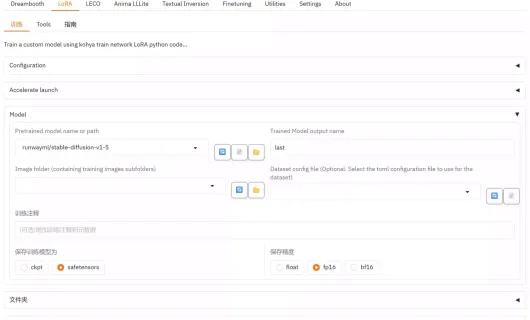
Kohya_ss is an open-source free web-based training GUI tool. It is not developed by any company, and is independently maintained by developer bmaltais. It is a Gradio wrapper built on top of the sd-scripts training codes written by kohya-ss, which converts complicated command-line training workflows into a visual web interface.
It targets AI artists, independent designers, AI training institutions and commercial creation studios. It is used to perform lightweight fine-tuning on pre-trained image base models and produce custom adapters. It supports multiple mainstream training methods, including LoRA, LyCORIS (LoHa, LoKr, LoCon), DreamBooth, Textual Inversion, full model fine-tuning, regularization training and model format conversion.
It supports a wide range of base models: Stable Diffusion 1.5 / SD2.x, SDXL, SD3, SD3.5, Flux.1, as well as open-source Chinese image models such as HunyuanImage and Anima. It also works well with widely used community variants including Pony, NoobAI and AnimagineXL. Users can manage datasets, configure captions, adjust hyperparameters, monitor training progress, preview validation samples and export trained adapters directly on the web page, without writing long command lines, greatly lowering the barrier of image model fine-tuning.
Many learners and training institutions choose to learn this tool for clear reasons. Its memory optimization for SD1.5 and SDXL has been polished for years, making it run stably on consumer GPUs. It exposes nearly all critical training knobs, such as learning rate, optimizer, gradient accumulation and data augmentation, which is ideal for learning fine-tuning principles. A huge amount of tutorials, preset configurations and troubleshooting records have been accumulated over the years, so most common errors can be resolved with community search results, making it perfect for teaching.
Even though the GUI repository does not receive frequent new commits and is not a cutting-edge new project, it remains widely adopted in the community and training industry. First, its training pipeline for SD1.5 and SDXL is stable and highly reproducible. Many training institutions have built their courses, datasets and teaching cases around this tool; switching to newer training tools would require full reconstruction of all teaching materials. Second, the underlying core sd-scripts repository is still actively maintained to support new models. Moreover, LoRA and LyCORIS files exported from Kohya_ss have excellent cross-ecosystem compatibility with Civitai, ComfyUI and other mainstream image generation tools, and it has become a de facto standard for image fine-tuning. It is built on the PyTorch deep learning framework, with bitsandbytes, xformers and accelerate for quantization, attention acceleration and memory management.