Skip to content

n8n 1.x
A workflow automation platform supporting no-code/code dual-mode building
Features
Screenshots
System Requirements
Minimum 8GB RAM. Low storage requirement (4GB reserved).
Windows 10/11 64-bit: No dedicated GPU required.
macOS 11+: Intel or M-series chips supported.
The standalone installation is only suitable for experiencing features. For production use, deploy in a cluster (e.g., k8s). Contact our team for support.
Introduction
1. Project Positioning
n8n is a workflow automation platform that balances "no-code convenience" and "code flexibility". Developed by n8n.io (founded by Jan Oberhauser, CEO), its core goal is to help technical teams quickly build automated workflows while retaining full control over data and deployments. It currently has over 51,309 Stars on GitHub and an active open-source community.
2. Core Features
- Visual + Code Dual-Mode Building: No complex programming skills are required for basic use—you can splice workflows via a drag-and-drop visual interface. For customized needs, you can directly write JavaScript/Python code and import npm packages, catering to both "beginners" and "advanced users".
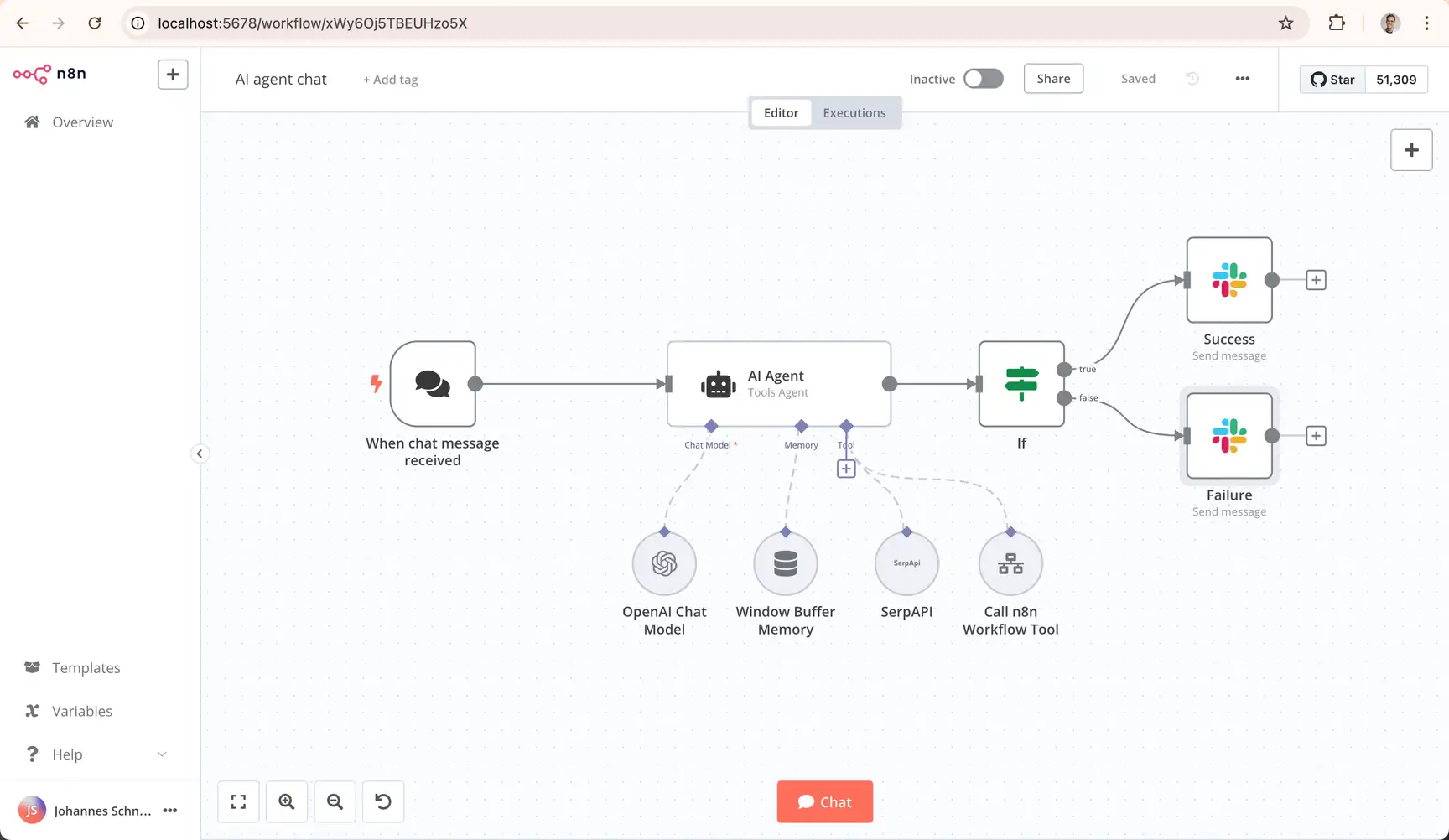
- AI-Native Capabilities: It supports building AI Agent workflows based on LangChain, allowing access to custom data and models. For example, it can automatically use AI to analyze chat messages and call tools (e.g., SerpAPI for searches) to generate responses, without the need to write complex AI logic manually.
- 400+ Tool Integrations: It has built-in integration with over 400 commonly used tools/platforms (e.g., WeChat, DingTalk, OpenAI, databases, cloud storage like AWS S3). No need to develop interfaces—just drag and drop to "connect" different tools (e.g., after receiving a DingTalk message, automatically extract keywords with AI and sync them to a database).
- 900+ Ready-to-Use Templates: The community provides over 900 pre-built automation templates, such as "auto-sync email attachments to cloud storage" and "auto-publish AI-generated copy to social media". Beginners can directly apply templates without building from scratch.
3. Applicable Industries and Scenarios
| Industry | Typical Usage Scenarios |
|---|---|
| Internet/Tech Companies | 1. After product launch, automatically sync logs to an analytics platform and generate daily reports; 2. After collecting customer feedback, use AI to classify and assign to the corresponding department |
| E-Commerce | 1. After successful order payment, automatically send SMS notifications + update inventory; 2. Regularly monitor competitor prices with SerpAPI and alert when prices drop below a threshold |
| Content Creation/New Media | 1. After AI generates a draft, automatically sync it to a Graphite document for review; once approved, publish to WeChat Official Account + Xiaohongshu; 2. Use AI to automatically reply to common fan questions |
| Corporate Office/Administration | 1. After an employee submits an expense report, automatically verify the amount compliance—if compliant, push to finance for approval; if not, return it; 2. Automatically summarize last week's attendance data into a spreadsheet every Monday |
| Data Analysis/Scientific Research Teams | 1. Regularly crawl third-party data (e.g., weather, industry reports), automatically clean it, and store it in a database; 2. After data updates, automatically run analysis scripts and generate visual charts |
4. Underlying Technology and Technical Features
(1) Core Underlying Technologies
- Programming Languages & Frameworks: The frontend mainly uses TypeScript, with Prettier and ESLint to ensure code standards; the backend is based on Node.js and supports a native Python task runner to meet multi-language development needs.
- Deployment & Containerization: It supports Docker deployment (with built-in Docker configurations like .dockerignore and the docker/images directory), enabling quick setup on servers or cloud platforms; it also supports container orchestration tools like Kubernetes for enterprise-level large-scale deployment.
- Dependency Management & Building Tools: It uses pnpm as the package manager (pnpm-lock.yaml, pnpm-workspace.yaml), which is more efficient than npm/yarn; the Turbo build tool (turbo.json) optimizes the build speed of multi-package projects and supports parallel task processing.
- Testing & Quality Assurance: It integrates Jest and Vitest for unit testing, Cypress for end-to-end testing (the cypress directory), and Codecov for test coverage monitoring (codecov.yml) to ensure code stability; it also uses Lefthook (lefthook.yml) for Git hooks to automatically run lint checks before code submission.
- AI Technology Integration: It implements AI Agent functions based on the LangChain framework, supporting access to OpenAI, local large models, etc., and allows custom AI memory (e.g., Window Buffer Memory) and tool call logic.
(2) Technical Features
- Flexible Deployment: It supports "self-hosting" (deployed on the enterprise's own servers, no data outflow) and "cloud deployment" (using n8n's official cloud service), meeting different enterprises' data security needs (e.g., the financial industry can choose self-hosting to avoid data leakage).
- High Scalability: It provides custom node development capabilities—enterprises can develop exclusive integrations (e.g., connecting to internal ERP systems) based on their needs; it also supports "air-gapped deployments" to adapt to scenarios with high network security requirements (e.g., government, military).
- Enterprise-Grade Security: It supports SSO (Single Sign-On) and OIDC authentication, which can be connected to the enterprise's existing identity system; it has detailed permission management (e.g., different roles can only operate specified workflows) and provides the SECURITY.md document to clarify security standards and vulnerability response processes.
- Open-Source & Auditable: It adopts the "Fair-code" license, with fully open-source code (all core code is visible on GitHub), allowing enterprises to audit code security and avoid "black box" risks; it also supports community contributions (the CONTRIBUTING.md provides contribution guidelines), and feature iterations rely on community feedback.
5. Core Advantages
- Balance Between "No-Code + Code": Compared to pure no-code tools (e.g., Zapier), n8n supports custom code to meet complex scenarios; compared to pure code development (e.g., writing Python scripts), it provides a visual interface to lower the threshold—suitable for both beginners and experts.
- Full Data Control: In self-hosting mode, data is stored on the enterprise's own servers, without passing through third parties, solving the "data compliance" pain point for industries like finance and healthcare; cloud deployment also provides enterprise-grade data encryption to protect privacy.
- Low Cost & High Cost-Effectiveness: The open-source version is free to use, with no basic license fees for enterprises; enterprise editions (for advanced features like SSO and dedicated support) are available at a cost 80% lower than custom-developed automation systems.
- Active Community & Fast Iteration: There are dozens of code commits on GitHub every week (last updated in September 2025), and the community continuously contributes new integrations and templates; problems can be addressed on the official forum (community.n8n.io) with fast responses.
Homepagehttps://n8n.io/
LicenseSustainable Use License and n8n Enterprise License