
Octop
multi-user, multi-agent AI assistant — expert teams, long-term memory, RAG knowledge bases and IM / browser / remote-desktop automation, getting to know you the more you use it
Note: Please open in the PC Client. Go to download >>>
Features
System Requirements
Minimum 8GB RAM. Low storage requirement (1GB reserved).
macOS 15+: Supports both Intel and M-series chips.
Windows 10/11 64-bit: No specific GPU requirements.
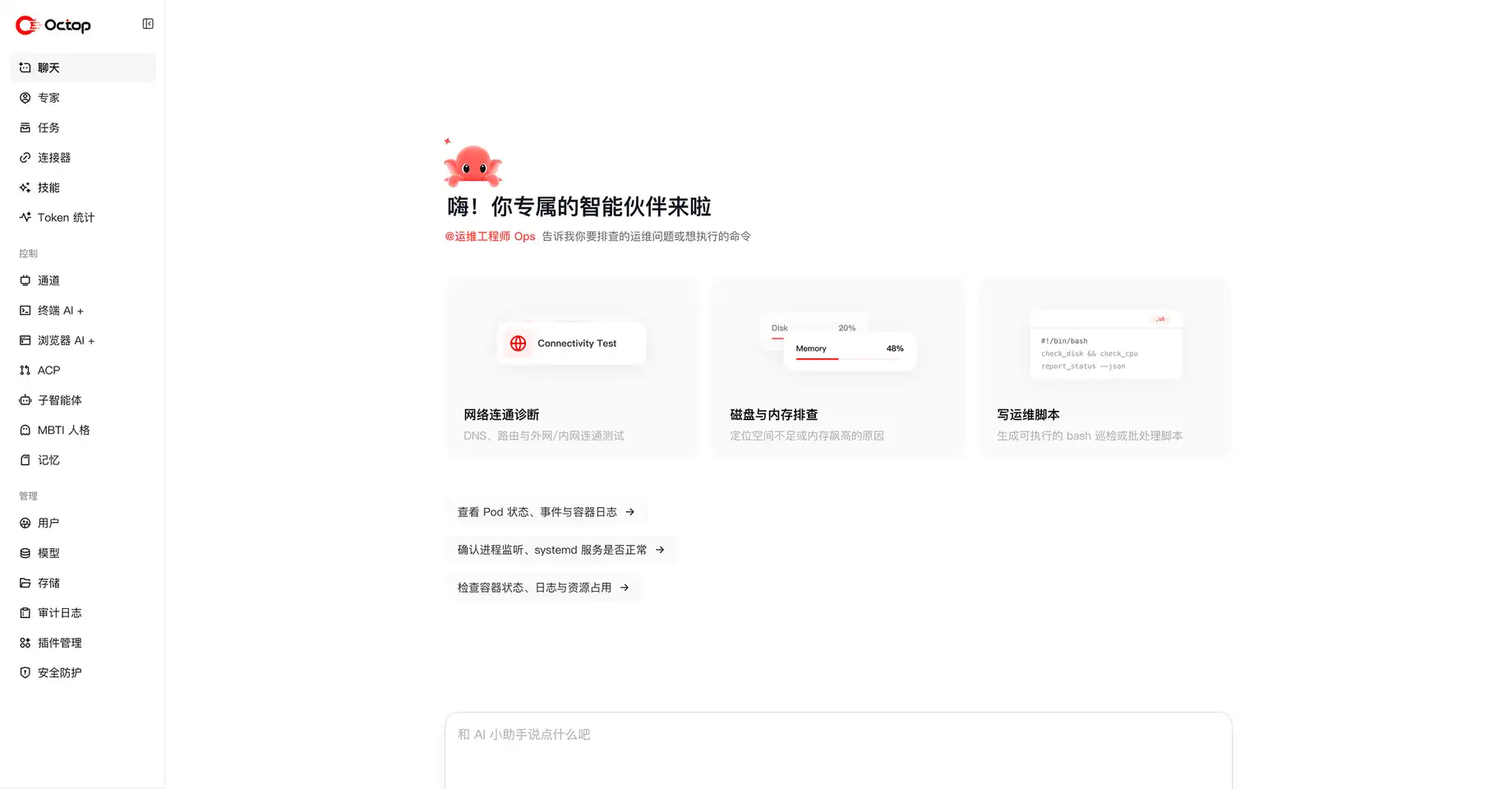
Screenshots

Introduction
Octop is an open-source AI assistant platform from Tencent Cloud, built around multi-user, multi-agent collaboration. Think of it as a parallel-running "digital team": it sets up an environment for individuals, families and teams that is both independent and collaborative. Every agent has its own role, memory and toolset, and gets more useful over time as conversations, task orchestration and automations accumulate.
What it lets you do:
- A dedicated personal assistant — let a specialized agent write weekly reports, organize notes, summarize material and manage your schedule, persisting your preferences and context so it fits you better the more you use it.
- Expert teams — configure multiple "experts" per user, each with its own persona, model, channels and scheduled tasks; AgentTeams (Beta) lets a coordinator split multi-step work across several experts in parallel.
- Personable agents — 16 MBTI persona templates, an interactive quiz and custom system prompts give each agent a distinct, consistent character and voice.
- Chat anywhere — besides the web dashboard, connect Feishu, DingTalk, QQ, WeChat, Telegram, Discord, WeCom and more, so you collaborate with your assistant right inside the messaging apps you already use.
- Browsing and web work — Browser AI+ drives a browser to fill forms, fetch, screenshot and browse remotely; remote desktop lets you view and operate graphical interfaces from the dashboard for tasks that only exist in a GUI.
- Developer boost — ACP integrates with IDE / terminal workflows to delegate coding to specialist coding agents, and an AI-assisted in-browser terminal helps you run commands and troubleshoot.
- Automation and cron — configure recurring jobs in natural language so the agent pushes reminders, pulls information and runs batch tasks on schedule.
Product highlights:
- Portable long-term memory — hierarchical recall with full-text search keeps an agent's memory accumulated with its workspace and travelling with it, for more coherent, context-aware answers.
- Private knowledge base (RAG) — turn your documents into a searchable corpus shared within a deployment, grounding answers in your own material rather than generic guesses.
- Connect to external systems — Connectors support both OAuth and an MCP gateway, plugging in the Tencent suite (Docs, Meeting, News and more) to keep extending what the assistant can reach.
- Plugins and ecosystem — extend Octop with third-party plugins, toggle bundled ones on demand; an expert library and expert market make "hiring an expert" as easy as installing an app.
- Cross-instance collaboration — link your instance to another to browse and borrow peer experts and chat across instances, while history stays on the expert's own side.
- Security built-in — multi-user isolation, tool-call approval, shell command guardrails and PII redaction; sensitive actions require confirmation, and your data and execution stay in your own environment.
- Guided first run — a setup wizard configures models, channels and permissions so you are up and running quickly.
Limitations: the assistant's real capability depends on the models and credentials you connect; advanced features such as IM channels, remote desktop and browser automation require the corresponding configuration and permissions to be enabled.