

Sand3D
A programmatic 3D library for LLMs, describing parametric assemblies with short Python code and exporting articulated assets for simulation, games and CAD
Note: Please open in the PC Client. Go to download >>>
Features
System Requirements
Minimum 16GB RAM. 5GB+ storage recommended.
macOS 15+: Supports M-series chips.
Windows 10/11: NVIDIA GPU with 4GB+ VRAM recommended.
Note: For NVIDIA GPUs, install a newer driver.Screenshots
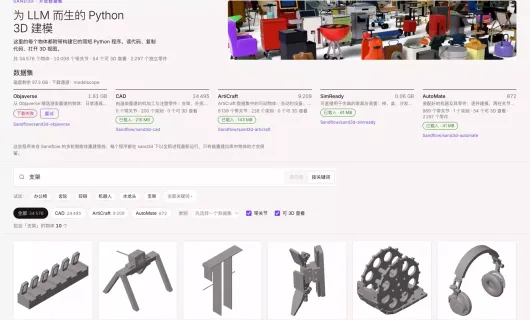
Introduction
Sand3D is an open-source Python 3D modeling library and large-scale 3D dataset released by Sandflow, a startup based in Lyon, France. It is built for large language models (LLMs). Instead of storing 3D assets as triangle meshes, it represents 3D objects as human-readable, parameterized short Python programs.
You describe shapes by sketches, solids, boolean operations, assemblies and joints rather than editing vertices manually. All dimensions are parameterized so you can re-generate the model instantly by changing values. It natively supports articulated joints and motion limits. The official dataset contains 106,094 standardized 3D assets, among which over 10,000 are articulated objects, covering household items, CAD mechanical parts and simulation assets, all written in Sand3D code.
Most existing 3D generation pipelines output raw meshes, which are heavy, token-expensive, hard to reparameterize and difficult to rig automatically. Sand3D follows the “program-as-3D” paradigm. A complete assembly can be described with very few tokens. LLMs can read, generate and modify Sand3D code, then the interpreter reconstructs mesh assets deterministically. It is built on top of Blender’s bpy API. The whole API is compact (~3600 tokens), easy to inject into LLM system prompts. It supports one-click export to GLB, USD, URDF, OBJ, STL and IFC for robotics, games, BIM and 3D printing workflows.
Detailed Use Cases
AI Agent / LLM-native 3D generation Provides a machine-understandable 3D representation for LLMs and AI agents. The language model outputs Sand3D code directly to generate parameterized, articulated assemblies, avoiding raw mesh complexity. Ideal for building text-to-parametric-3D pipelines.
Robotics simulation and embodied AI datasets Export URDF and USD for ROS, MuJoCo, PyBullet, Isaac Sim and NVIDIA Omniverse. Batch-generate articulated furniture, tools and components for robot manipulation, navigation and grasping training.
Parametric CAD & industrial prototyping Mechanical engineers and product designers can rapidly iterate parametric parts and assemblies. Adjust dimension parameters to regenerate geometry, and export STL for 3D printing.
Game and real-time 3D asset production Export GLB for Unity and Unreal Engine. Suitable for bulk creation of interactive props such as cabinets, appliances and tools with built-in joints for animations like opening doors and sliding drawers.
BIM and architectural modeling IFC export is supported for Revit, ArchiCAD and other BIM platforms, for parametric building components and equipment families.
Training data for 3D foundation models The official 100k+ dataset uses a unified program representation. It is well suited for training code-based 3D foundation models, helping models learn structural, assembly and joint logic better than mesh datasets.
Education and research on AI + 3D graphics For computer graphics and embodied AI research, as well as student projects. It lowers the barrier to parametric procedural modeling and serves as a clean baseline for academic work.
Custom AIGC tools and low-code 3D platforms Developers can wrap Sand3D into web or app tools, letting users generate editable parametric 3D props from natural language prompts.