Skip to content

BackApp Details
MOSS-Transcribe-Diarize
Delivers single-pass transcription, speaker diarization, and timestamping for long audio across 50+ languages
Note: Please open in the PC Client. Go to download >>>
Features
Supported Languages
System Requirements
16GB RAM recommended.11GB+ storage recommended.
macOS 15+: Supports both Intel and M-series chips.
Windows 10/11: Intel/AMD GPUs supported, NVIDIA GPU recommended.
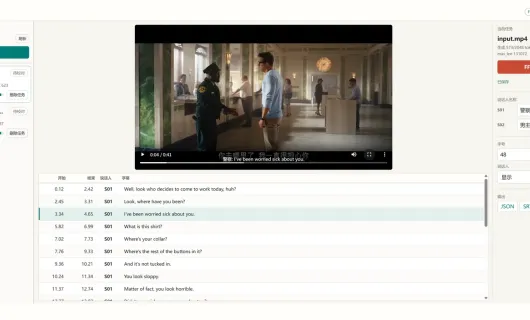
Note: For NVIDIA GPUs, install a newer driver.Screenshots
Introduction
MOSS-Transcribe-Diarize is an open-source, next-generation audio understanding large model developed by the OpenMOSS Team at Fudan University.
Core Features & Highlights
- All-in-One Transcription & Speaker Diarization: Upload a multi-speaker audio file, and it simultaneously converts speech to text while automatically identifying who is speaking (labeling speakers as
[S01],[S02], etc.). - Precise Timestamps: Automatically tags the start and end times for every sentence, making it easy to export directly into standard subtitle files.
- Acoustic Event Recognition: Beyond speech recognition, it detects background environmental sounds such as laughter, applause, and coughing.
- Long-Form & Multilingual Support: Processes up to 90 minutes of continuous audio in a single pass across 50+ languages.
Ideal Use Cases
- Meeting Minutes: Automatically processes multi-party discussions and generates transcripts with clear speaker attributions.
- Interviews & Podcasts: Converts dialogues and interviews into well-structured, speaker-labeled transcripts.
- Video Subtitle Generation: Automatically creates precise, timestamped subtitle files for long-form video content.
- Lectures & Classrooms: Efficiently transcribes long educational recordings into text notes.
Underlying Technology
- End-to-End Speech LLM Architecture: Unlike traditional pipelines that chain separate ASR (speech recognition) and Diarization models together, this project utilizes a compact 0.9B parameter end-to-end multimodal speech LLM. It generates text, speaker labels, and timestamps simultaneously in a single forward pass.
- Lightweight & High Efficiency: With only 0.9B parameters, it achieves state-of-the-art accuracy while maintaining low GPU memory usage, making it ideal for local and lightweight deployment.
LicenseApache-2.0